What was a cutting-edge skill in 2023 is a baseline expectation in 2026. What once required a team of specialists is now being handled by a single professional fluent in both analysis and intelligent automation. And what was once the exclusive domain of large enterprises with deep R&D budgets is now being built by startups, hospitals, banks, and government departments across every Indian city.
This guide is for you if you are an IT professional wondering whether your current skills are keeping pace, a student trying to understand which direction to grow in, or someone from a non-technical background asking whether data science and AI is genuinely accessible. According to NASSCOM 2026, India has fewer than half that number in active roles than actually needed by Industries. That gap is your opportunity, and understanding the trends shaping this field in 2026 is the first step toward positioning yourself to benefit from it.
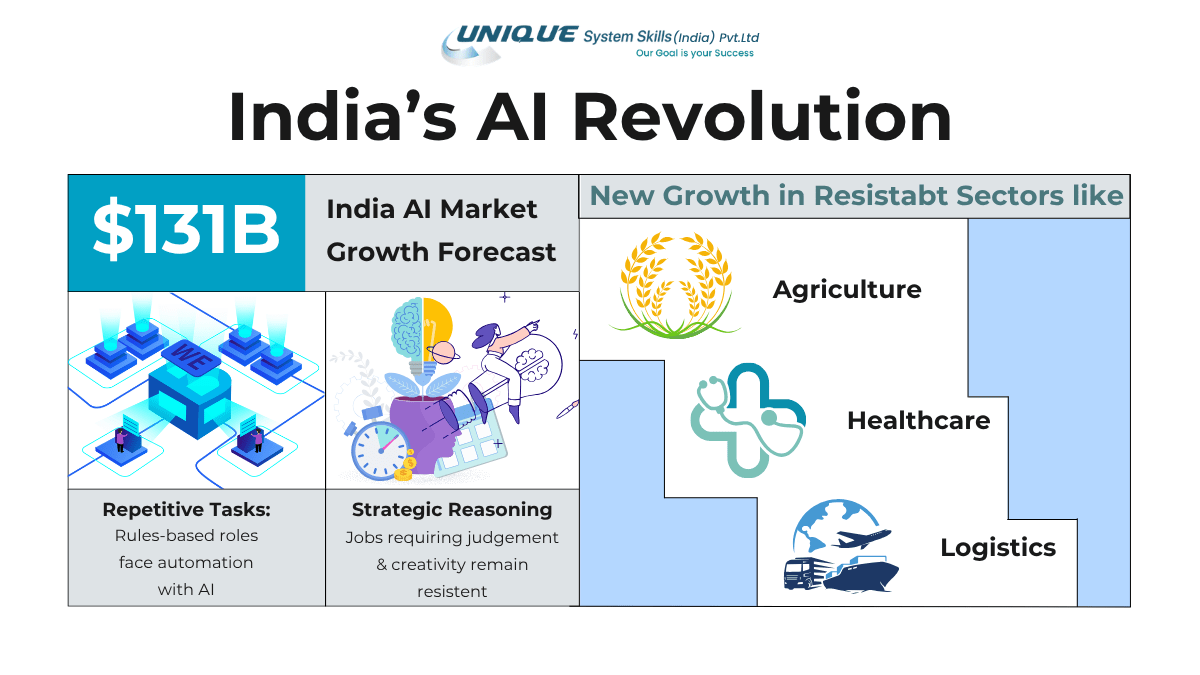
India’s AI Revolution
The foundational purpose of data science and AI has always been to turn raw data into useful knowledge. But the nature of that knowledge has changed dramatically. In 2022 and 2023, most enterprise data science work was retrospective. Analyzing historical data to understand what had already happened and why was an optional endeavor.
By 2026, the leading edge of the field has shifted to real-time intelligence. With systems that do not just explain the past but adapt to the present, making decisions in milliseconds based on live data streams became the norm.
This shift is visible across every major Indian industry. In banking, real-time fraud detection models flag suspicious transactions before they complete rather than flagging patterns in monthly reports. In manufacturing, predictive maintenance systems monitor equipment sensor data continuously and schedule repairs before failures occur. In healthcare, patient-risk models update dynamically as new vitals are recorded, enabling clinical teams to intervene earlier and more precisely.
These are live deployments running on Indian infrastructure right now, and they require a specific combination of data science and machine learning proficiency that is genuinely different from the batch-processing analytics skills that dominated the field three years ago. Thus, the Rise of AI and Machine Learning has changed the skills required to succeed in today.
Automation in Data Science
One of the most significant and least-discussed trends reshaping data science and AI in India is the rise of automation in data science. Understanding this correctly is important, because it is frequently mis characterised as a threat to data professionals when it is actually a multiplier of their value.
Automation in data science takes several forms in 2026.
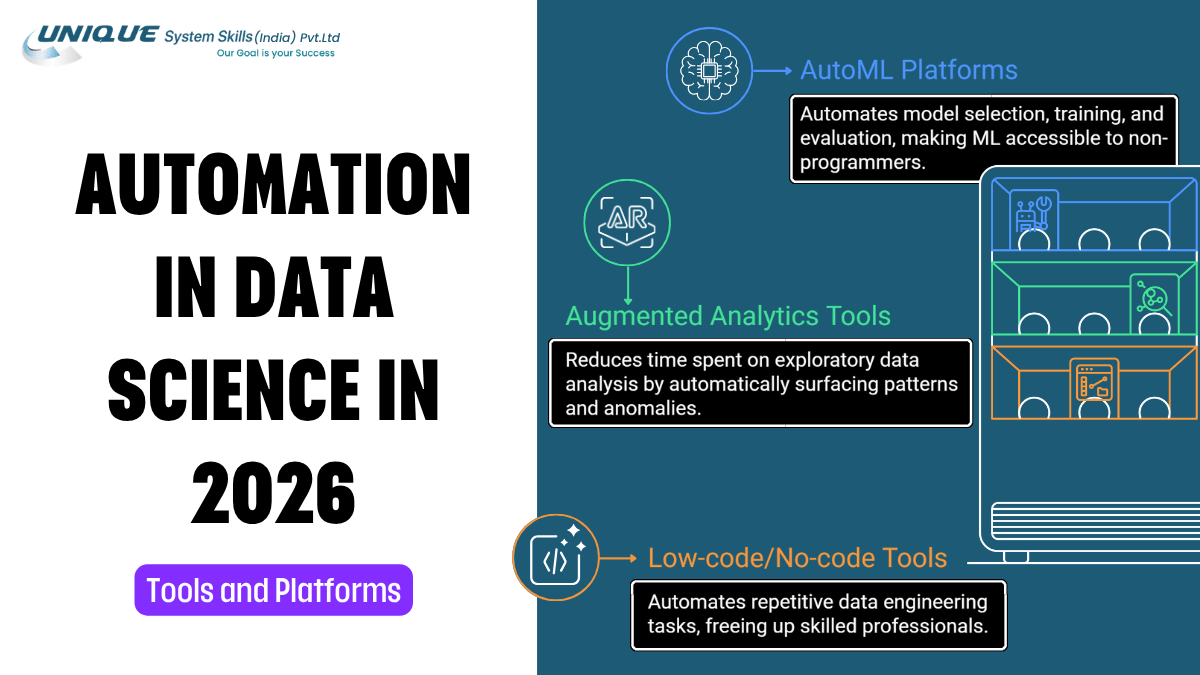
Automation in Data Science 2026
What this means in practice is that the value of a data science and AI professional in 2026 is not in their ability to perform routine tasks quickly. The value is in their ability to ask the right business questions, interpret ambiguous and contradictory results, design experiments that produce trustworthy conclusions, and communicate findings in a way that drives real decisions.
This is why 86% of Indian employers say AI has redefined roles rather than eliminated them. The need for human judgment at the strategic layer of data work has grown as routine work has been automated. Automation in data science is raising the floor of what they are expected to deliver. Therefore, the professionals who thrive in this environment are those who understand both the automated tools and the business context they serve. This evolution connects directly to a broader integration that is reshaping how intelligence is built and deployed at enterprise scale.
Data Science and Machine Learning
The integration of data science and machine learning has moved well beyond the classroom definition of training a model on historical data. In 2026, data science and machine learning in production means building systems that learn continuously from new data, adapt to changing conditions without manual retraining, and operate reliably at the scale and speed that enterprise applications demand.
A recommendation system for an e-commerce platform needs to serve suggestions based on past purchase history and dynamically weights real-time browsing behaviour along with current inventory levels, margin priorities, and seasonal demand signals. This system also needs to keep updating its recommendations for each user session based on the combined signal. Building this kind of system requires not just machine learning knowledge but a working understanding of data pipelines, feature stores, model serving infrastructure, and monitoring systems that detect when a model’s performance is degrading in production. This is the data science and machine learning skill set that the most competitive data science and machine learning jobs in India are screening for in 2026. Read more about how this shift is playing out in Pune’s job market specifically.
Generative AI: The Skill Layer That Changes Everything
The arrival of ChatGPT in late 2022 and the subsequent acceleration through GPT-4, Gemini, Claude, and open-source models like Llama has not just created new products. It has created a new layer of required competency for every data science and AI professional.
In 2026, companies are hiring people who use ChatGPT and also want those professionals to understand:
- How Large Language Models (LLMs) are trained
- Where LLMs fail,
How to engineer prompts that produce reliable outputs at scale - How to build Retrieval-Augmented Generation (RAG) pipelines that connect LLMs to custom knowledge bases for context-aware responses.
Understanding transformer architectures at a conceptual level, even without implementing them from scratch, is now expected of candidates applying for most mid-to-senior data science and AI roles.
For students and professionals who want to build this foundation systematically, USS’s Data Science with AI training covers the full stack from Python and machine learning fundamentals through to Generative AI, LLM integration, and production. For those in the middle of their career, the AI Fundamentals Course provides the conceptual and practical foundation from which the Generative AI layer becomes genuinely learnable.
Explainable AI and Data Ethics
One of the most important trends in data science and AI in 2026 is the growing demand for Explainable AI (XAI) and responsible data science practice. AI systems are taking on higher-stakes decisions like approving or rejecting loans, flagging medical anomalies, scoring job candidates. Therefore, their ability to explain their reasoning in plain language has moved from a nice-to-have to a regulatory and reputational requirement.
In India’s BFSI sector specifically, AI-driven credit decisions are now subject to increasing scrutiny from the Reserve Bank of India and consumer advocacy groups. A model that rejects a loan application must be able to explain which factors drove that decision in terms that a non-technical compliance officer can review and a customer can understand. This has created a new category of data science and machine learning jobs in India focused specifically on AI governance, bias auditing, and model explainability. These roles combine technical proficiency with the kind of domain expertise and ethical reasoning that pure technical training rarely develops.
Data privacy and security are equally central to this. India’s Digital Personal Data Protection (DPDP) Act has started tightening requirements around how organisations collect, store, and process personal data. This is why data science and AI professionals who understand privacy-preserving machine learning are commanding premiums that reflect the scarcity of this specific combination of skills. If you are a non-technical professional wondering whether this field has a path for you, building a data science career from domain like finance, healthcare, or law is increasingly an asset.
AI and Data Science Projects: Building a Portfolio That Gets Hired
In a market where 58% of companies report that skills mismatch is their biggest hiring challenge, a certificate is the starting point of a job application. What converts a qualified candidate into a hired one in 2026 is a documented portfolio of ai and data science projects that demonstrate real, applied competence on real, imperfect data.
The most effective ai and data science projects portfolio follows a progressive structure.
Foundational Projects: A Sentiment Analyser built on Twitter data, an Image Classifier trained on the MNIST dataset to demonstrate that you can work through the complete model development lifecycle.
Intermediate Projects: A credit risk prediction model built on real financial data or a customer churn predictor for a SaaS business scenario can demonstrate domain awareness and the ability to connect technical output to business decisions.
Advanced Projects: An end-to-end RAG pipeline that connects an LLM to a custom document knowledge base, or a fine-tuned open-source model deployed via a Hugging Face Space can demonstrate the Generative AI capability that is commanding the highest interview attention in the current market.
Every project in your portfolio should be documented on GitHub with a clear README that explains the business problem, your methodology, your results, and what you would do differently next time.
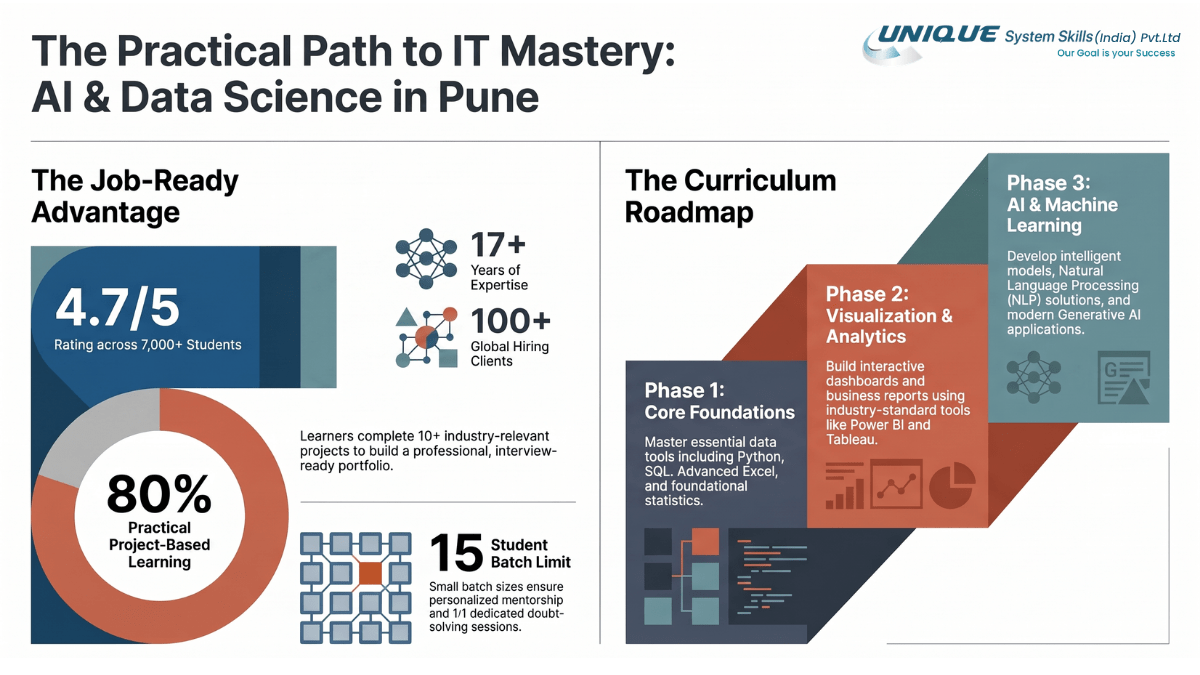
The difference between ai and data science projects that impress and those that do not is almost always the quality of the documentation and the specificity of the results claimed. USS’s Data Science with AI programme is built around completing at least 10 such industry-relevant projects using real-world data that mirrors what candidates will encounter from day one of employment.
Data Science and Machine Learning Jobs in India: 2026 Salary Benchmarks
The data science and machine learning jobs in India landscape in 2026 is defined by strong demand, meaningful salary progression, and a geographic spread that gives professionals increasingly viable options outside the traditional Bengaluru hub.
The Salary ranges in the country range from:
- Fresher (0-2 Years): Range from ₹5–12 LPA
- Mid-level (3-5 Years): Range from ₹14–28 LPA
- Senior Professionals with Specialization (6+ Years): Range from ₹25–60+ LPA
The role landscape within data science and machine learning jobs in India has also diversified significantly when it comes to senior roles.
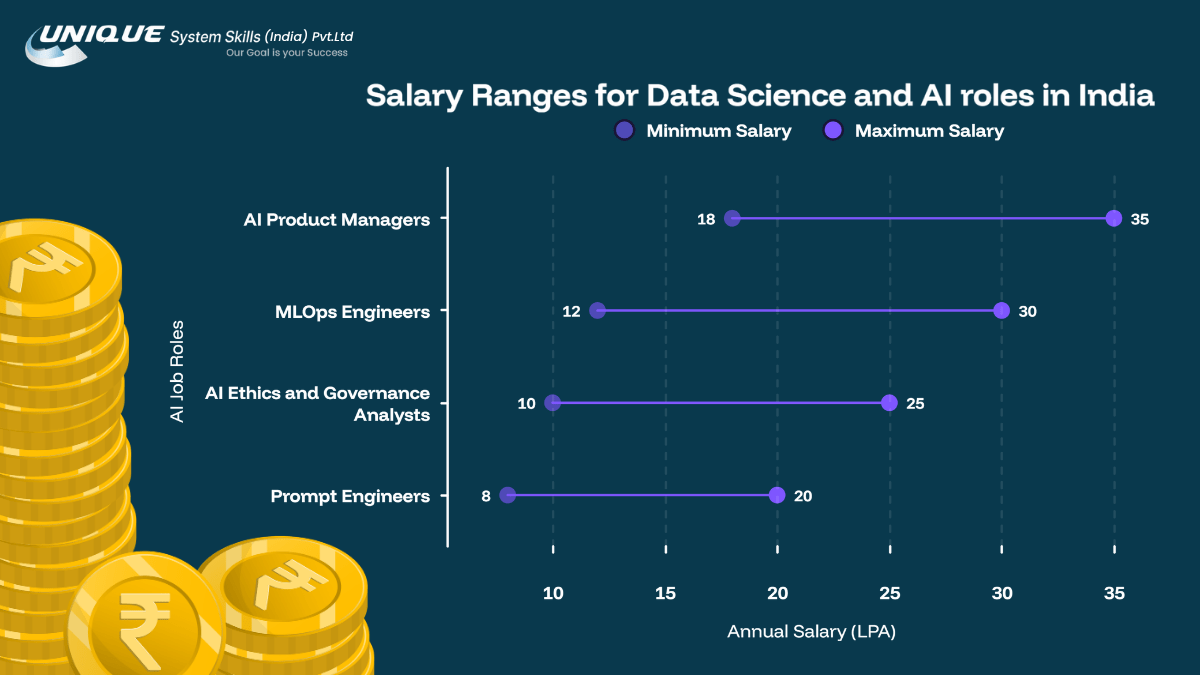
Salary Ranges for Data Science and AI roles in India
Each of these roles reflects a different aspect of the data science and AI ecosystem described throughout this guide.
Why Unique System Skills Is the Right Partner for Your 2026 Data Science Journey
Unique System Skills (USS) was built to close the gap between watching tutorials and being genuinely interview-ready. In a market where the majority of hiring failures happen because candidates know the terminology but cannot clean a real dataset or write a working SQL query without assistance, USS’s model addresses the root cause of the problem rather than its symptoms.
Every USS data science and AI programme is delivered in batches capped at 15 students, enabling the individual mentorship and same-day doubt resolution that large-format programmes cannot provide. Trainers are active industry professionals rather than full-time educators, which means the curriculum reflects what is being tested in interviews right now rather than what was relevant two or three years ago. As Maharashtra’s first USA-based IT training institute, USS aligns its programmes with the hiring benchmarks of both Indian enterprises and global MNCs, giving graduates a profile that is competitive in both markets.
including the Data Analytics course, and the AI Fundamentals course
Whether you are a fresh graduate exploring the field, an IT professional looking to specialise, or a non-technical professional making a career transition, the right starting point is a conversation with USS’s expert counselling team. We can help you with to identify which programme aligns with your background, your timeline, and your specific career goals including the Data Analytics course, and the AI Fundamentals course.
The Window Is Open — For Now
Data science and AI in India in 2026 is not a trend that is approaching. It is a transformation that is actively underway, and the professionals who are building practical, documented, market-relevant skills right now are entering a labour market that is structurally undersupplied and competitively compensated. The market gap is not going to close itself, it will be closed by individuals who made the decision to invest in the right training at the right time.
With the right curriculum, the right project portfolio, and the right placement support, the path from where you are today to a meaningful data science and AI career in India is a structured, achievable journey. The window is open. The only question is when you choose to walk through it.
Frequently Asked Questions
What are the top data science trends?
The biggest shifts in 2026 are the move from retrospective, batch-based analysis to real-time intelligence that adapts to live data streams, alongside the growing rise of automation in data science that is raising the floor of routine work while increasing the value of human judgment. Generative AI has become a core skill layer rather than a specialisation, and Explainable AI and data ethics have moved from optional to regulatory requirements, particularly in BFSI. Together, these trends define what strong data science and AI practice actually looks like in India today.
What is the future of data science?
The future points toward deeper integration between data science and machine learning, where systems learn continuously and operate at production scale rather than being retrained manually on a schedule. NASSCOM’s 2026 data shows India has fewer than half the professionals industries actually need, meaning demand for data science and AI talent will likely stay structurally undersupplied for years to come, especially for professionals who combine technical skill with Generative AI fluency and domain expertise.
Is data science still a good career in 2026?
Yes, and the numbers back this up clearly. Fresher salaries in data science and machine learning jobs in India range from ₹5–12 LPA, climbing to ₹14–28 LPA at mid-level and ₹25–60+ LPA for senior specialists, with 86% of Indian employers reporting that AI has redefined roles rather than eliminated them. Combined with a persistent talent shortage and growing geographic spread beyond Bengaluru, data science and AI remains one of the strongest career bets in Indian tech.
How is AI changing data science?
AI is reshaping data science along two tracks at once: automation in data science is handling more of the routine, repetitive work, while the integration of data science and machine learning is pushing professionals toward building continuously learning, production-grade systems rather than one-off models. On top of this, Generative AI has added an entirely new required skill layer, from prompt engineering to building RAG pipelines, that did not exist as a baseline expectation just a few years ago.
Is AI and data science the same?
Not quite, though the two are increasingly inseparable in practice. Data science is the broader discipline of turning raw data into useful knowledge through analysis, statistics, and communication, while AI and machine learning are the specific tools within that discipline used to build predictive, automated, and intelligent systems. In 2026, the strongest data science and AI professionals are fluent in both, which is why this guide treats them as one integrated skill set rather than two separate fields.